Introduction
Over the course of this Spring, I have sought to develop my skills and familiarity with the various translation technologies, both established and developing, that have a large impact on the language industry. The point of this project was to get a more holistic view at the different Translation Management Systems (TMS) available in the market today and see if we could recommend one to a theoretical mid-sized gaming company. If you want the gist of it all, feel free to skip to the Lessons Learned video below. Otherwise, keep reading to get a more a comprehensive look at the project.
Alternatively, if you want to look at the other project I simulated this Spring, make sure to check out the NMT Project.
The Point of the Project
As the Translation and Localization industry has exploded over the years, several different types of tools and technology have become available and widespread. One of these technologies was the Translation Management System (TMS) which serves as an aggregator for all of the diffrent and complex functions needed for translation. TMS Systems often include project management functions, CAT (Computer Assisted Translation) Tools, QA functions, Terminology and Glossary Management processes, Translation Memory management, among many other useful and necessary functions. Because of their position as the center of most translation processes in any given company, they have become invaluable to the modern localization team. With the invaluability has come an explosion in the amount of TMS platforms available, and an increased necessity in the ability for localizers to screen for and find the TMS that suits their needs.
This project involved my team and I doing just that: choosing a type of company, in our case a mid-sized gaming company, and trying to narrow down and find the most suitable TMS for its needs. First, let’s take a look at the five TMSs we took a look at.
Meet the TMSs
Evaluating the TMSs
If you want a comprehensive view of our project, please watch the video below where we walk through the evaluation process and offer our final recommendation.
To avoid boring you with unnecessary details, we decided that we would grade each TMS based on 8 key features:
Scalability
How much the TMS would allow for us to grow should we expand?
Cost
How much the TMS costs and what plans are available?
Usability
How easy is it to use the TMS and also teach someone else how to use it?
File Formats
How many file formats does the TMS accept and does it have any restrictions?
Workflow Managment
How does the TMS handle the creation and tracking of workflows?
Cloud Capabilities
Is the platform fully online and easily accessible?
Integrations
How many integrations with different and key programs does the TMS support?
AI
What steps is the platform taking to integrate and make AI a key feature?
The Results
After some investigation, we put our qualitative findings into chart organized green-yellow-red. In the following chart, green indicates that we found the TMS to excel in this area, yellow indicates that the TMS was good but unremarkable, and red indicates it was missing or otherwise confusing. This was meant to ‘weed out’ some TMSs, freeing us to do a more in depth investigation into the others.
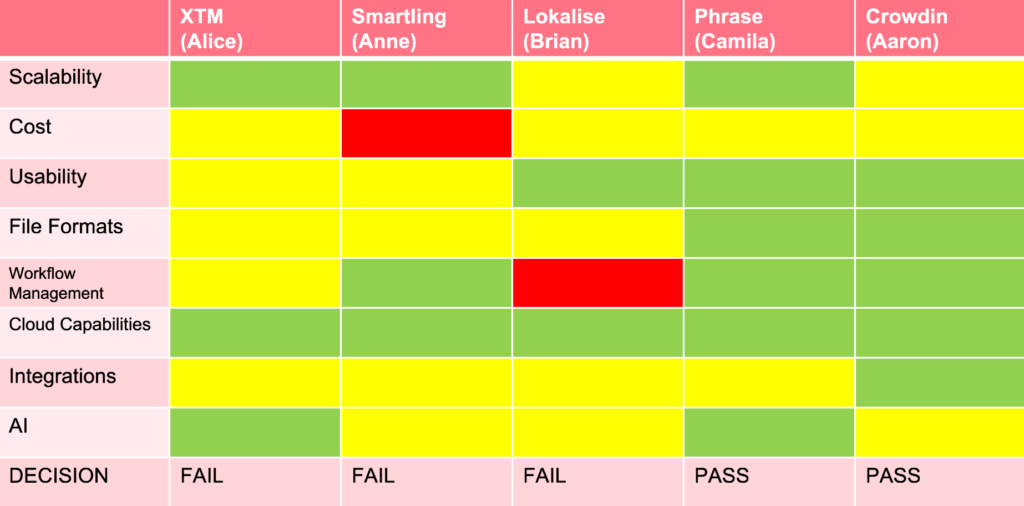
According to this evaluation, we found that we would not recommend XTM, Smartling, or Lokalise to a mid-sized gaming company. The remaining two, Phrase and Crowdin warrented further investigation.
As we dove deeper into both Crowdin and Phrase, we knew we needed to create a scorecard to have a more quantitative and comprehensive evaluation. We first decided which features from our list of 8 we felt were more important, and assigned to them a higher multiplier than those that were less important. We then tested each TMS with the features in mind and gave them a score of 1-3 for each feature, with 3 indicating the TMS exceeded expectations.
You can see the final scoring represented in the table below. If you want a detailed walkthrough of Crowdin vs. Phrase for each feature, make sure to watch the video above.
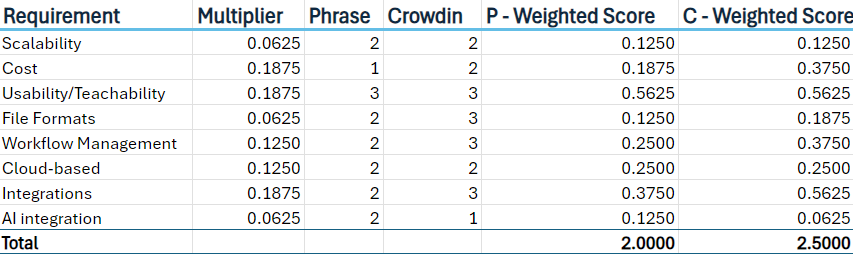
After the math was done, our weighted score for Phrase was 2, while our weighted score for Crowdin was 2.5, thereby giving us our winner: Crowdin.
In conclusion, for a mid-sized gaming company, I highly recommend the Crowdin TMS. Yay Crowdin.